The Power of Human Connection: A Surgeon's Perspective on Communication, Empathy, and Patient-Centered Care
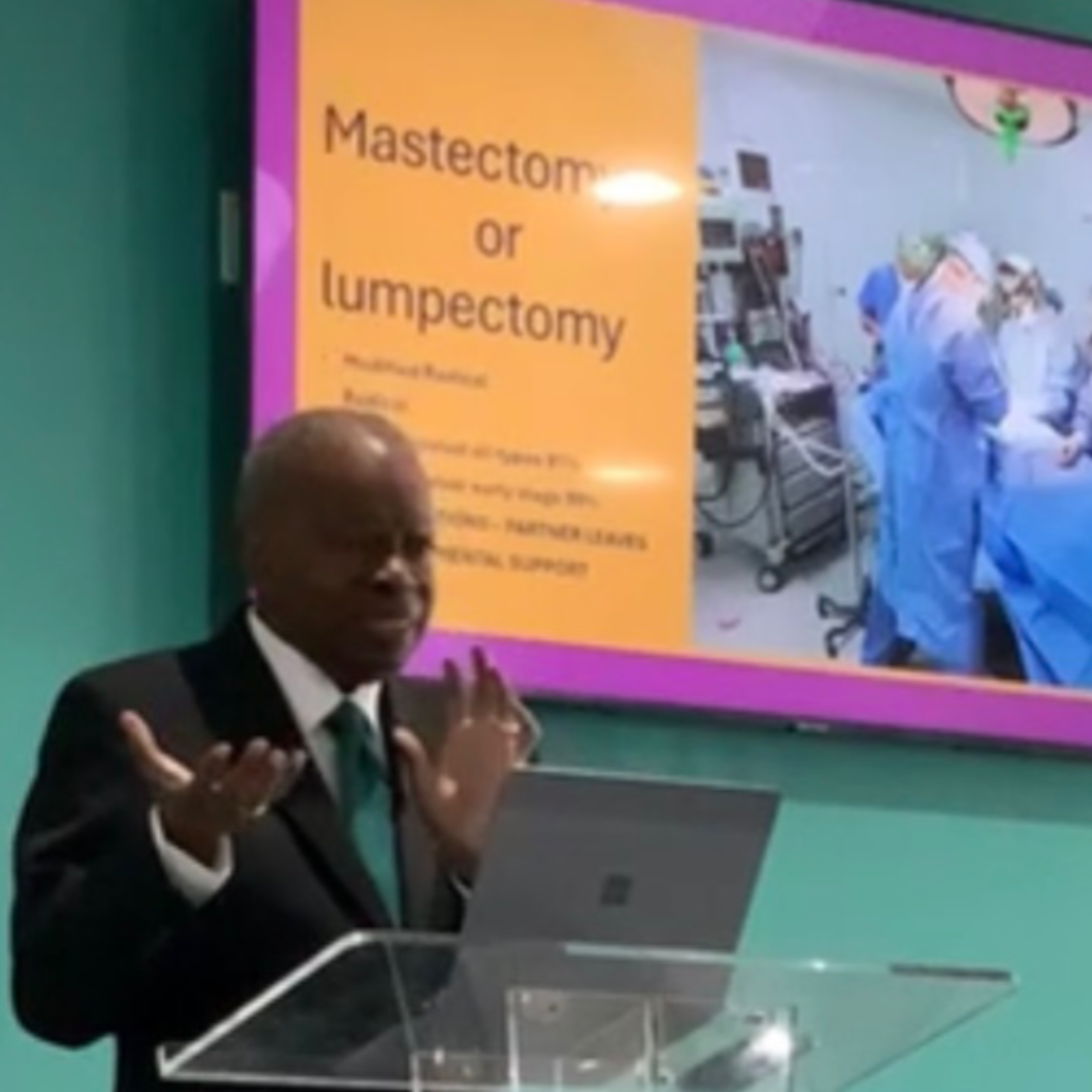
Dr. Choctaw shares valuable insights from his surgical practice, emphasizing the importance of effective communication, empathy, and building strong patient-doctor relationships. He discusses the emotional and psychological impact of a cancer diagnosis and offers guidance on navigating difficult conversations and treatment decisions.
0:00 Coming up on this episode of the Healthy, Wealthy Wise podcast. The ultrasound can tell you whether the lump that you feel in your breast is filled with fluid or if it's solid. Why is that important? Welcome to the Healthy, Wealthy Wise podcast with Dr. William T. Choctaw, MD, JD. This podcast will provide you with tools and actionable information you can use to help live a more healthy, wealthy, and wise life. It's powered by By the over 50 years of medical experience of this Yale University Medical School trained surgeon who is also a Western State Law School trained attorney with executive experience being a former mayor of Walnut, California, as well as the current chairman of the nonprofit Servants Arms and as president of Choctaw Medical Group, Incorporated.
0:55 This is the Leadership Masterclass Edition, already in progress. Ways to lower your breast cancer, um, uh, uh, number one, uh, is to examine your breasts regularly. Uh, have your regular mammograms and again, talk to your doctor in terms of based on your age and healthcare, uh, history, how soon you should get a screening mammogram. Um, um, and that, that those have to decrease your risk. Well, when should you call a doctor? Well, I would say whenever you feel a lump, you should go and have that evaluated by a physician. Because you don't know what the lump is. Uh, and so, you need to then have an evaluation to decide what that lump is.
1:42 Other signs of the breast when you evaluate your breast are, again, if you feel something in your breast, take a look at your breast. Is there a different color of your breast? Is there an area that looks different from the way it last looked? Does the nipple look normal? Is part of the nipple inverted or changed? All those changes of the breast could be exemplary of some form of breast abnormality like breast cancer. So, one of the things that increase your risk as a woman, and I'm going to stick with women right now, of developing breast cancer, well, age, age.
2:27 If you're getting older, and I'm going to say your risk of breast cancer at 60 is greater than your risk of breast cancer at 30. Because what we know is that as we get older, the breast cancer risk increases. Second point, being female increases your risk of developing breast cancer. Now, let me quickly add, men also get breast cancer. Men get breast cancer. It's not as common, obviously, uh, but it does happen and, and I've seen it, when men get it, it's usually worse. And one of the reasons it's usually worse because men tend to wait, you know, they tend to say, no, this, this can't be anything important for me, you know, blah, blah, blah, blah, blah, blah.
3:16 So breast cancer is not singularly a female problem. It is not. And it's important to keep that in mind. But the majority of the people who get breast cancer are women and that's where we'll have most of our discussion today. Um, uh, and so that is something you want to be concerned about. If you have very dense, um, uh, breast tissue, you have very large breasts. Many times you can get breast cancer because a lot of times individuals with very large breasts, it's hard to examine the breasts carefully and critically. If you've had previous breast cancer, obviously that increases your risk of having breast cancer.
3:59 Um, different ethnic groups, um, Caucasian women have a higher incidence of breast cancer than non Caucasian women. Um, uh, but non Caucasian women have a higher risk of death from breast cancer than Caucasian women. And the belief is that, uh, non Caucasian women may wait longer, there may be financial reasons, there may be insurance reasons, et cetera, et cetera, but, but those with some of the numbers show. If you've had radiation therapy for some other problem, that might increase your risk. for breast cancer. Uh, again, if you had children and you did not breastfeed, that might increase your risk for breast cancer.
4:40 If you drink, some studies have suggested that might increase your risk and something called the BRCA gene. And we'll talk about that later on as, as, as we go. Oh, again, let's, let's go over what, what are the tests you've examined your breasts. Let's say you feel something. You go in and see your doctor. He says, okay, I want to get some blood tests and I want to, I don't want you to have a mammogram. Sometimes your doctor may suggest an ultrasound. Well, what's the difference between an ultrasound and a mammogram? The mammogram is more specific. But the ultrasound is unique in that the ultrasound can tell you whether the lump is a cyst or whether it's solid.
5:25 Think about that. The ultrasound can tell you whether the lump that you feel in your breast is filled with fluid or if it's solid. Why is that important? Because chances are, if it's filled with fluid, it's a cyst, and it's benign. It's not a cancer. Okay? Uh, and if it's solid, it's more likely, um, uh, to be a cancer than if it has fluid in it. Uh, the doctor may order an MRI, which can give an even more specific diagnosis. type of exam, um, or a diagnostic test of what that lump is. So again, if one were to look at a mammogram, you can't really, the average person can't really look at a mammogram and tell you a 50 millimeter lump is there.
6:13 And if it's there, uh, whether, whether that lump is, is a cancer or not. On the screen now is a picture of a mammogram. If you were able to see this. Um, um, one of the ways, and last year we did a whole master class on artificial intelligence. Well, artificial intelligence is growing in, in healthcare like wildfire. And one of the areas of artificial intelligence, another area that is beneficial is in radiology. Think about it. Radiologists basically look at an x ray. They look at a fem, and they may use a magnifying glass or whatever, but they look for certain distortions and changes on that film to decide whether that's significant or not.
6:58 Um, you can do an algorithm with the, um, um, uh, with, with, with, uh, the advanced knowledge of, of today's. Uh, uh, mammogram, uh, and other types of, of tests, uh, and with the artificial intelligence and the A. I. can tell you instantly whether that's, um, an abnormality or not. The A. I. is just faster and smarter, basically, than we humans. And certainly one of the places is in radiology. Uh, again, Diagnosis, exam your breast, examination of your breast, mammogram, ultrasound, um, uh, basically blood test, possible MRI.
7:43 Well, what about, what is treatment for the breast lump? Without a doubt, there's nothing more discomforting for a patient than for her doctor to say, We're going to need to send you to a surgeon, uh, being a surgeon, nobody, nobody, nobody wants to come to see me. You do not want to go see a surgeon. This old doctor can send me anywhere, but don't, don't send me to a surgeon. I can tell you, I can tell you, and trust me. I have been on both sides of that. I've been both patient and doctor, so I, I, I understand it from both perspectives.
8:26 But one of the things that I would do in, in my practice, um, is I would always keep that in mind. Um, I would try to always be respectful. I, I would try to always slow down, uh, in what I'm saying and how I'm saying it. And I would try to, um, as some people say, read the room. And what, what do I mean by reading the room? Um, I believe that most communication is non verbal. Now, we talk all the time, and we talk back and forth, and blah, blah, blah, blah, blah. I believe that often, many times, the words get in the way of communication. Get in the way. If you doubt that, you go and just sit in an audience.
9:08 Church, don't say anything, just sit, and listen, and look. And you'll learn all sorts of things, right? Uh, uh, and, and you'll learn a lot. Uh, but you don't have to talk, you don't have to put your words out there. What, what's my point? My point is that what I try to do is to understand the communication that my patient has given me when she walks into the door, through the door. I'm terrified of you, I'm scared of you, I don't trust you, I don't know what's going to happen, I think I'm going to die, on and on and on and on and on and on and on. And then I, you know, have her to take a seat and then I say, okay, let's, let's, let's, let's, let's, let's go down your list one at a time.
9:54 And I tell myself, I take as much time as I need, um, and, um, that's really, I think what's important in terms of patients who have even the possibility of a cancer. When you mentioned the C words. Most patients, many patients, don't hear anything else you say. You can talk for an hour. All they heard is you said they had cancer. And they're saying, oh my god, blah, blah, blah, blah, blah, blah. So, when they come to see the surgeon, they come to see us and come to see me because they need some type of surgery. So what type of surgery do we do? with, with individuals with, with, uh, cancer, breast cancer.
10:35 There are two main types early on. One is called a biopsy. Well, what is a biopsy? Again, let's go back to the law. We have a law. A biopsy means I take a piece of the law. I don't take the whole law. I take a piece of the law. If I do an excision or I excise the law, it means I take out the whole law. Okay. Biopsy means you take a piece of something excision means you remove the whole thing. So my goal is always to remove the whole law, right? I always want to remove the whole thing.
11:16 Why? Because if, if someone has a love and you take a piece of it, how do you know? that what you took is cancerous, more importantly, how do you know that what you left behind is not cancerous, right? So ideally, if possible, you want to take out the whole lump, and not only do we want to take out the whole lump, we want to take out the whole lump with the margin of normal tissue around us, around it, because that's how you know you removed the whole lump. So we call that an excisional biopsy. Now, if you remember what I said earlier, that most of the times, most patients are not able to feel a lump in their breast, even when they have one, because the lump is too small, which is a good thing.
11:59 And that's why the mammogram is so important, because the mammogram can show you lumps. that are too small for you to feel. So then you said, but then doctor, you were just telling me how you remove the lump. How do you do that? Well, uh, when the radiologist does the mammogram, uh, and identifies the lump, he then puts a little band needle. under x ray all the way down to the lump. He injects a dye through that needle, a little blue dye around the lump. And what he is doing, he is creating a roadmap for me or any other surgeon to be able to know where the lump is and to be able to size the whole lump.
12:40 So it's, it is a delicate process. Um, I, I say all the time about the importance of relationships, that surgeon radiology relationship is really important. You know, because I'm saying blah, blah, blah, and he's saying blah, blah, blah, and she's saying this and that. But that's how we remove the lumps. That's how we remove them. And that works well over 98, 99 percent of the time, okay? Fortunately, most people, most of the time, the lumps are not cancerous. Most of the time, the lumps are not cancerous. So, we've talked about excising the lump, we've talked about the presence of the lump.
13:21 Um, what about spread of the cancer? One of the reasons why we surgeons want to get that cancer out as fast as possible is we don't want it to spread. Why is that? Because once the cancer spreads, It's a whole different ballgame in terms of treatment and in terms of condition and in terms of survival, right? Once that lump is localized, the cancer is localized, treatment and eradication of the cancer is much easier. Once it spreads to the lungs or to the bones or to the brain, uh, then it's a whole different ballgame. And now you're talking about radiation, you're talking about chemotherapy.
14:02 So the smaller the lump is, the more localized the lump is. the better the prognosis is for the patient. What are the main types of surgery other than excisal valve that we do as, as breast cancer surgeons? Well, one procedure we do is called a mastectomy. Mast meaning breast, ectomy meaning removal of. So, mastectomy is removal of the entire breast. Removal of the entire breast. Mastectomy can be either a modified radical mastectomy or radical mastectomy. What's the difference?
14:42 A modified radical mastectomy means I remove the entire breast plus lymph nodes. A mod, a radical, that's a modified radical. A radical mastectomy. Mastectomy means I remove the entire breast and muscle. No one does, hopefully, radical mastectomies anymore, hopefully, uh, because studies now show that there's not a great deal of difference between doing a modified radical and doing a radical mastectomy. In other words, in general, there's not a good reason to remove the muscle and the breast. You just remove the breast, okay? Now, as you might imagine, removing the breast is a big deal.
15:25 Not only is it a big deal physically, it's a big deal mentally. It's a big deal psychologically. Um, and I've, I've, I've gone through this with certainly over a hundred patients. Uh, and again, everybody's a little different. Everybody's a little different. Some patients don't care. Say, I don't care. Take it. I, I, no problem for me. Um, other patients, it is, it is, it is like their world, basically. And so then a decision has to be made. Decision has to be made. Um, as a physician, my role is to give the facts. Pro and con. Um, Physicians have a duty to inform, patients have a right to refuse.
16:11 Physicians have a duty to inform, patients have a right to refuse. The majority of patients, my experience, 95 plus, will follow whatever the physician says. Basically, um, so those are the, so we're talking about the lumpectomy where you excise the lump, remove the entire lump, um, um, if, uh, the lump is removed, is cancerous and the cancerous is an invasive type of cancer. And what do I mean by an invasive cancer? It's a cancer that is growing beyond the margins of border of the lung. That's considered invasive.
16:51 It is invading. It is moving, if you will, as compared to a cancer that's in situ, that's sitting, it's not moving, sitting cancers. You can remove them in their entirety and you don't have to do anything else in general. Uh, invasive cancers are the ones where you look at doing possibly a mastectomy or something more than just removing the lung. for listening to the Healthy, Wealthy, and Wise podcast with Dr. William T. Choctaw, MDJD. You can listen again to this and any of the previous episodes by Leave a comment or pose questions to the doctor by going to www.
17:32 thwwp. com, that's www. thwwp. com and you've got it. It's also available wherever you get your podcasts. Be sure to follow, like, share and subscribe if you haven't already, then tune in for the next episode of the Healthy, Wealthy and Wise podcast with Dr. William T. Choctaw, MD, JD, and Dr. William T. Choctaw, MD. Be sure to tune in next week for another episode of the Healthy, Wealthy and Wise podcast. Production of Changemakers Communications, LLC.
